Tuesday, October 14, 2014

Quinoa Caesar Salad

Quinoa Caesar Salad is a great way to incorporate the knowledge I have gained about punk cuisine and the knowledge that I have gained about Quinoa. This tasty meal could work as an entrée or a quick appetizer, depending on how busy you are. It represents punk cuisine by being vegan. Yes, you will have to actually buy these ingredients from your local whole foods store if you don't already have them. That means no stealing from grocery stores or trash cans! This recipe is quick and easy, it only takes 45 minutes and has the potential to feed up to 8 people. It doesn't matter if you're vegan, vegetarian, or carnivorous. Quinoa Caesar salad does not discriminate. This recipe was made available by Isa Chandra Moskowitz and can be found on the post punk kitchen blog.


Quinoa Caesar
http://www.theppk.com/2013/11/quinoa-caesar-salad/

For the Breaded Tofu:
3/4 cup fine storebought breadcrumbs (I use whole wheat)
1/2 teaspoon dried thyme, crushed between your fingers
1/2 teaspoon dried rosemary, crushed between your fingers
1/2 teaspoon dried basil
1 teaspoon garlic powder
14 oz extra firm tofu, sliced into 8 slabs widthwise
3 tablespoons tamari or soy sauce
For The Briny Caesar Dressing:
1/2 cup cashews, soaked for at least 2 hours and drained
1 head roasted garlic (about 10 cloves, see tip)
2 cloves fresh garlic
1/4 cup capers, with some brine
3/4 cup water
Several dashes fresh black pepper
1/2 teaspoon salt
2 tablespoons nutritional yeast
2 tablespoons grapeseed or olive oil
1/4 cup fresh lemon juice
For the rest:
6 cups cooked and cooled quinoa
8 oz chopped romaine
4 oz baby arugula (or chopped arugula)
1 avocado, cut diced into 1/2 inch pieces


Make the Breaded Tofu:
Preheat a large non-stick pan, preferably cast iron, over medium-high heat. On a dinner plate, use your fingertips to mix together the breadcrumbs, dried herbs and garlic. On a separate plate, pour the soy sauce.
Place a tofu slab in the soy sauce, and toss to coat. Then dredge them in the breadcrumbs, tossing to coat. (Use your dry hand to handle the tofu in the breadcrumbs, otherwise you’ll get a crumb mitten on your hand.) Put coated tofus off to the side of the plate and continue until all tofu is coated. Put a thin layer of olive oil in the pan, and then transfer tofu cubes to the pan. Let cook for a few minutes then flip, using a thin metal spatula so that you don’t scrape off the breading. Cook for about 7 minutes total, adding a little extra to the pan as needed, and flipping occasionally until browned on most sides.
Once browned, remove from pan and slice on a bias into 1/4 thick pieces.
Make the dressing:
Simply add all of the ingredients to a small blender or food processor, and puree until smooth. Scrape down the sides every now and again to make sure you get everything. Thin with a little water, if necessary. Keep tightly sealed and refrigerated until ready to use. Keeps for up to 5 days.
Assemble:
Assemble the salad in a very large mixing bowl. Toss the greens with the quinoa, and then add the dressing. Serve topped with tofu and avocado!

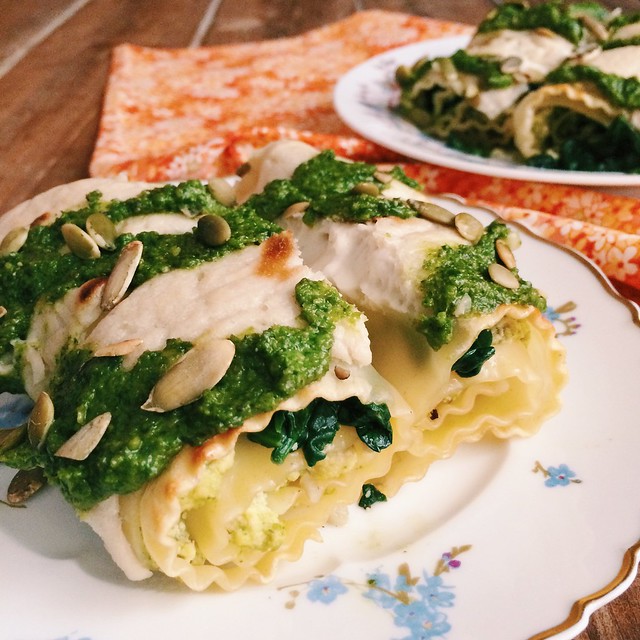
Green Lasgana Rolls


This yummy recipe stays true to the vegan way of eating that punks follow. The pesto, spinach and pumpkin seeds make this zesty dish stay true to their culture and own nonconformist group.


It’s basil season! And spinach season! And, well, let’s just say it’s lasagna roll season, too.
These make a great appetizer if you’re doing a little summer entertaining, or a filling entree if you prefer. Tofu ricotta is elevated with the addition of some Pumpkin Seed Pesto. The mellow flavor of pumpkin seeds really lets the basil shine. The sautéed spinach is really really garlicky, as is the pesto, so this makes the perfect date night meal.
What I really love, besides how flavorful these are, is the texture. Baking the rolls makes the noodles soft but still toothsome, with little crunchy bits on the edges. Smothered in cashew cream and pesto and finished off with a scattering of additional pumpkin seeds, these lasagna rolls will fulfill even the most wild fantasies: creamy, crunchy, velvety, chewy, and hearty all at once. Yes, there are a few components here, but none are too difficult to pull off and also LASAGNA ROLLS.
Serve with Caesar Salad to round out the meal!
 
Recipe Notes
~You don’t need all of the lasagna noodles called for, but go ahead and boil the whole package to account for some breakage. Saute the leftovers and broken ones for dinner the next night.
~The amount of ricotta made is just enough to fill the rolls, so go easy with the taste testing and don’t overfill the rolls, or you might not get ten out of the deal.
~I put the pesto in a little plastic bag with a hole cut out of the corner to pipe it nicely over the rolls. Then just spread it a bit with a spoon and it’s real pretty like.
~I make the white sauce before the pesto to cut down on cleaning a little bit. You can pour the white sauce out and then just rinse the blender without having to do a major cleaning, since who cares if a little bit of cashew cream ends up in your pesto.
 
12 oz lasagna noodles
For the white sauce:
1 cup cashews, soaked for at least 2 hours
1/2 cup water
2 teaspoons cornstarch
1/2 teaspoon salt
For the pesto:
2 cloves garlic
3 cups fresh basil, loosely packed
1/2 cup pepitas (shelled pumpkin seeds), plus extra for garnish
1/3 cup olive oil
2 tablespoons nutritional yeast flakes
1 tablespoon fresh lemon juice
1/2 teaspoon salt
Several dashes fresh black pepper
For the ricotta:
1 14 oz extra firm tofu, crumbled
1/4 cup pesto
2 tablespoons nutritional yeast
1 tablespoon olive oil
1 tablespoon fresh lemon juice
1/2 teaspoon salt
For the spinach:
2 tablespoons olive oil
6 cloves garlic, minced
10 oz baby spinach
Make the noodles:
Bring a big pot of salted water to boil and cook the noodles al dente, stirring occasionally to make sure they don’t stick together. If they seem to be, use metal tongs to gently peel them apart. Once cooked, drain them in a colander and run them under plenty of cold water to make sure they stop cooking and don’t stick together.
Make the white sauce:
Drain cashews. In a blender, combine all ingredients and blend until completely smooth. This could take 1 to 5 minutes depending on your blender. Scrape down the sides of the blender with a rubber spatula every minute or so to make sure you get everything. Set aside.
Make the pesto:
Place garlic cloves in a blender and pulse a bit to chop. Add basil, pumpkin seeds, olive oil, nutritional yeast, lemon juice salt and pepper and blend. It should still have some texure and not be completely smooth. Thin with a few tablespoons of water to get it into a spreadable consistency.
Make the ricotta:
In a medium mixing bowl, mash tofu with your hands or an avocado masher, until it resembles ricotta cheese. Mix in pesto, nutritional yeast, olive oil, lemon juice and salt until well combined. Set aside.
Make the spinach:
Preheat a large heavy bottomed skillet (preferably cast iron) over medium low heat. Add the olive oil and garlic and saute until fragrant, about 30 seconds. Add spinach and cook, stirring often, until wilted, about 3 minutes. Set aside.
Assemble and bake:
Preheat oven to 350 F. Lightly grease a 9×13 inch casserole dish with olive oil.
Spread 3 tablespoons of ricotta mixture evenly over each lasagna noodle, leaving a little room around the side edges and 1/2 inch at each end.

Scatter about 3 tablespoons of spinach mixture over the ricotta. Starting at the bottom end, roll noodle up and place, seam side down, in the casserole dish. Continue with all remaining noodles. Pour the white sauce over the rolls in thick ribbons.

Bake for 20 to 25 minutes, until edges are lightly browned and white sauce is thickened. If after 25 minutes the rolls are not browning but the edges are crispy, place under a broiler on low heat for a minute or two, keeping a very close eye so that they don’t burn.
Remove from oven and smother on remaining pesto. Garnish with additional pumpkin seeds and serve!

Marionberry Lavender Scones

by IsaChandra


Berry week! It’s like shark week, except more delicious. But I swear to god it’s just as dangerous. At our berry picking expedition I was stung by a hornet, pricked with thorns, tripped over a vine and scabbed at least one knee.
The other weird thing about berry week is that it begins on Thursday, skips the weekend and then continues on Monday. It’s more a berry business days.
Our first recipe is for Marionberry Lavendar Scones, and now that the weather is cooling down a bit for most of us, why not bake a dozen on Sunday morning? Lavender always seems like a foofy kind of ingredient, only suitable for the kind of person that talks about the “legs” on wine and the hickory undertones of chocolate. But, really, it’s just a nice fragrant taste that is the perfect backdrop for sweet tart berries. If you can’t get your hands on any, try 2 tablespoons of fresh chopped rosemary instead.
Scones are kind of a pain in the butt if you’re making them into triangles, so just do the scoop and drop method with these. They’re light and crumbly like a scone should be, and the batter isn’t too sweet but the light sprinkling of sugar on the tops is a perfect little sweet roof to bite through. We had to trudge through the mud to get the last of the marionberries so they might not be available everywhere right now. In that case, you can’t go wrong with blueberries, blackberries or raspberries.
Thanks to my berry cohorts, Kimmy Kokunut and Veganknitting! In the next few days, their recipe for Blueberry Ginger Jam. Kimmy actually did most of the work for these scones, I just closely supervised.
Marionberry Lavender Scones
Makes 12 scones
1 1/4 cups almond milk (or your non-dairy milk of choice)
2 teaspoons apple cider vinegar
3 cups flour
2 tablespoons baking powder
1/2 cup sugar, plus extra for sprinkling
1/2 teaspoon salt
1/4 cup fresh culinary lavender, chopped
1/2 cup non hydrogenated shortening
2 tablespoons canola oil
1 teaspoon pure vanilla extract
2 cups marionberries, or berries of your choice
Preheat the oven to 375 F. Lightly grease a baking sheet or line with parchment paper. Measure out the milk and add the vinegar to it. Set aside to curdle.
Mix together the flour, baking powder, salt and sugar in a large mixing bowl. Add the shortening in small clumps, then use your fingers to cut it into the flour until it appears like small pebbles. (You an also use a food processor for this, but I prefer to use my hands.) Mix in the lavender.
Create a well in the center and add the soy milk, oil and vanilla. Mix with a wooden spoon just a bit, then add in the berries. Mix again until everything is moistened, but don’t overmix. A couple of dry looking spots are just fine.
Use a 1/4 cup measuring up to scoop the scones out on to the baking sheet. Spray it wth cooking spray first so that the batter comes out easier.
Sprinkle tops with a bit more sugar, then bake for 18 to 22 minutes, until tops are firm to the touch and lightly browned. Serve warm!

Monday, October 13, 2014

Seitan & Waffles With Pomegranate Syrup

Seitan And Waffles

This non-traditional version of chicken and waffles follows true punk style, containing seitan instead of meat. It is also vegetarian and vegan, keeping true to punk ideals. In the description of the recipe, there was no personal narrative to explain the author's life story, but instead just a brief description of the intent behind posting and the recipe itself.

"Up until yesterday, I didn’t really get chicken waffles. But for Valentine’s Day, I decided to cave to societal pressure, and enjoy a juicy, savory, fried hunk of something over a carby, crispy something, covered in sticky sweetness. Even if it makes no sense! I mean, where is the kale? Where are the lentils? Sigh. OK.

Those thoughts plagued me as I stirred the batter and simmered the seitan, although each component was nice on its own. The waffles were perfectly crisp, and I knew they’d be able to handle the syrup without sogging up. The chicken-style seitan came out really flavorful, with a firm but tender texture. The breading on the seitan was totally delish and I couldn’t help but eat a piece straight out of the cast iron skillet. OK, maybe two pieces."

For the pomegranate syrup:
1 cup pure maple syrup
1/4 cup pomegranate molasses
For garnish:
Fresh pomegranate seeds
For the waffles:
2 cups almond milk (vanilla or plain), or your fave non-dairy milk
1 tablespoon organic cornstarch
1 tablespoon apple cider vinegar
2 cups all-purpose flour
3 tablespoons sugar
1 tablespoon baking powder
1/2 teaspoon salt
1/3 cup water
2 tablespoons canola oil
1 teaspoon pure vanilla extract
For the chicken:
1/2 batch (1 pound) Chicken Stylee Seitan, or equivalent storebought
Batter:
3 tablespoons flour
2 tablespoon cornstarch
1 cup water
Breading:
1 cup plain breadcrumbs
2 teaspoons dried thyme
1 teaspoon salt
Several dashes fresh black pepper
Vegetable oil for frying
Make the syrup:
Just mix the syrup and pomegranate molasses together in a measuring cup, yay!
Make the waffles:
In a 2 cup measuring cup, use a fork to vigorously mix about half the milk with the cornstarch, until fully dissolved. Add the remaining milk and the vinegar and set aside.
In the meantime, combine flour, baking powder, sugar and salt in a large mixing bowl. Make a well in the center.
Add the milk mixture to the flour along with water, oil, and vanilla. Mix until the batter is relatively smooth. A few lumps are a-OK.
Preheat waffle iron and let the batter rest. Cook according to waffle iron directions, spraying the waffle iron liberally with oil or cooking spray between each waffle is made.
Make the chicken:
Have ready a few layers of paper towels (or brown paper shopping bags) for absorbing the oil after frying.
We will bread the seitan before starting the oil. This way you don’t have to worry about overheating the oil while you bread. You’ll need to fry in two batches.
Slice each piece of seitan into 4 slices, on a bias, so that you have long wing looking pieces.
You’ll need a big plate for breading and a wide bowl for batter. In the bowl, mix together the flour, cornstarch and water. Mix vigorously until thick and smooth. Set aside.
On the plate, mix together the bread crumbs, thyme, salt and pepper.
Now let’s assemble!
Dip each seitan slice into the the wet batter, letting the excess drip off. Transfer to the breadcrumbs bowl and use the other hand to sprinkle a handful of breadcrumbs over the seitan, to coat completely. Make sure you use one hand for the wet batter and the other for the dry batter, or you’ll end up with club hand. Set each piece aside on a big plate, then start your frying oil.
Now let’s fry!
Preheat a large cast iron skillet over medium heat. Once hot, pour in about 1/2 an inch of oil. Wait about a minute. Now test the oil by throwing in a pinch of breadcrumbs. It should sizzle and bubble without smoking, then you know it’s ready. If it burns or smokes quickly, lower the heat. If it just sits there doing not much of anything, raise the heat.
Without overcrowding the pan, fry each piece of seitan for about 2 to 3 minutes on each side, until golden brown. Transfer to paper towels to drain the oil, and then do the next batch.
To serve:
Place a few pieces of seitan over the waffle. Garnish with pomegranate seeds and serve with plenty of syrup. ::SWOON::

http://www.theppk.com/blog/

Appleberry Pie WIth Olive Oil Crust

Appleberry Pie With Olive Oil Crust

by IsaChandra

Serves 8
Appleberry Pie
The wee infant hours of autumn are always bittersweet. This pie is a way to savor your summer memories while welcoming the new season in a delicious way. Sweet, tart berries meet lush apples, laced through with some warm spices and all wrapped up in your new favorite pie crust!                                                                                                                                                                                                         Made with pantry-friendly olive oil, this is a fast and convenient all-purpose crust ideal for fruit pies. It became mine and Terry’s go-to as we were writing Vegan Pie In The Sky; olive oil produces a light flaky crust with a surprisingly neutral taste that has just a hint of fruitiness. The secret is to freeze the olive oil before hand, so that it become partially solid. This helps the fat to blend into the dough in little pockets, creating the flakiness you crave.                                                                                                                                                                                                                                                                   Pie season is here, everyone! You’ve got plenty of time to practice for the holiday table. But really, who can argue with pie ever?
Recipe Notes
~To prepare the olive oil: About an hour before beginning the recipe, place the olive oil in a plastic container; for best results use a thin light container, like the kind used for take out food. Freeze until it’s opaque and congealed but still somewhat soft, like the consistency of slightly melted sorbet. If it’s over-frozen, that’s ok, just let it thaw a bit so that you can work with it.
~Refrigerate the flour before using. That helps to keep the dough cold while you work with it, which will produce a lighter, flakier crust.
~Keep that crust from burning by using a pie shield half-way through baking. Thisadjustable one is heaven sent!
For the Olive Oil Crust:
2 1/2 cups all-purpose flour
3/4 teaspoon salt
2/3 cup olive oil, partially frozen (see above note)
4 to 8 tablespoons ice water
1 tablespoon apple cider vinegar
For the Pie:
2 cups fresh blackberries, raspberries, blueberries, or a mix, fresh or frozen (about 10 oz)
4 cups peeled Granny Smith apples, sliced 1/4 inch thick (about 1 1/2 pounds)
2 tablespoons fresh lemon juice
2/3 cup sugar
3/4 teaspoon ground cinnamon
Big pinch of ground nutmeg
4 tablespoons cornstarch
For topping:
2 tablespoons almond milk (or preferred non-dairy milk)
1 tablespoon sugar
Prepare the pie crust:
In a large mixing bowl, sift together the flour and salt. Working quickly so that it stays cold, add the olive oil by the tablespoonful, cutting it into the flour with your fingers or a pastry cutter, until the flour appears pebbly.
In a cup, mix together 4 tablespoons of the ice water with the apple cider vinegar. Drizzle 2 tablespoons of the water and vinegar mixture into the flour, and using a wooden spoon or rubber spatula, stir into the dough, adding more water a tablespoon at a time until it holds together to form a soft ball. Take care not to over-knead the dough.
Divide dough in two, roll each half into a ball and press eachh into disk about an inch thick. Place one disk between two 14 inch long pieces of waxed paper. Use a rolling pin to roll each piece into a circle about 1/4 inch thick. Refrigerate rolled dough wrapped in waxed paper for at least 30 minutes, or until ready to use.
Assemble the pie:
Preheat the oven to 425 F.
Combine the filling ingredients in a large mixing bowl. Fit the bottom crust into the pie plate, pile in the filling, and gently press down to get everything in. Cover with the top crust, pinch the edges together, trim excess dough to about an inch, and crimp. Make five slits in the middle of the pie to let steam escape (a steak knife works great for this).
Brush the top of the pie with almond milk and sprinkle with sugar.
Bake for 20 minutes. Reduce the heat to 350 F and continue baking 35 to 40 more minutes, or until the filling bubbles up through the edges. Place the pie on a cooling rack and let cool for about 30 minutes before serving.

Homemade Feta Cheese

Homemade Feta Cheese

The Joy of Cooking trust


As with some of the other cheeses we've discussed on the blog, you will need a couple special ingredients: a mesophilic starter, rennet (this is often available at health food stores), and lipase (this
is optional). If you do purchase these items, store the starter and lipase in the freezer in plastic bags, and keep the rennet in the refrigerator.

Finally, don't let words like "mesophilic" and "lipase" ruin your fun. Think of these strange-sounding components as powdered flavor. They are what helps you, along with time and temperature, to turn milk into the stuff cheese-lovers' dreams are made of.

feta

About 1 pound, depending on the butterfat content of your milk


Combine and heat in a medium saucepan until it reaches 86˚F:
     1 gallon whole milk, preferably not ultrapasteurized
     (1/8 teaspoon lipase powder dissolved in 1/4 cup cold water)
Turn off the heat and add:
     1/8 teaspoon powdered mesophilic starter
Cover and allow the milk to ripen for an hour.
Add and stir with an up-and-down motion for about 30 seconds:
     3 drops double-strength rennet dissolved in 1/4 cup cold water (if using regular-strength rennet, there should be directions on the box or bottle telling you how much to use)
Cover and let the curd form for about an hour.
To test the curd, wash your hands well and, using the back of your hand, gently press the curd mass down at the edge where the curd meets the pan. The curd should pull away from the edge of the pan fairly neatly.
Cut the curd into 1/2-inch cubes and allow it to rest for 10 minutes.
Gently stir the curds for 20 minutes. At first, the curds will be fragile, but they will begin to firm up as they expel whey.
Pour the curds into a colander lined with a clean dish towel (I like to use flour sack towels as they aren't too thick to drain properly, and they're cheap enough to be expendable). If you like, save the whey for another application. My chickens love it. Otherwise, just drain the curds over the sink. Bring the corners of the towel together and tie them with kitchen twine. Hang the curds to let them drain. I hang mine from a hook over the sink, but you can hang it anywhere, provided you put a bowl beneath it to catch the whey as it drips.
Let the curds drain for 4 hours. Unwrap the curds, flip the curd mass, and hang it again for another 2 hours. This simply ensures an evenly-shaped cheese, but is not crucial. If you like, you can just hang the curds for 4 hours and be done with it. However, I think that even, adequate draining is important to the final product.
Unwrap the curds and cut into 1-inch squares. They don't need to be perfect. Toss the squares in a large bowl with:
     2 teaspoons kosher salt
Cover the cheese and allow it to continue draining for about 2 more days. Every so often, pour off they whey that has collected in the bowl. For this reason, I like to use a bowl with a spout. Be sure to keep the cheese covered tightly with plastic wrap. The first couple times you drain the cheese, you may have to manually separate the squares as they tend to want to knit together until they firm up a bit.
When the cheese stops emitting whey, make a brine solution using:
     2 cups cool water
     2 tablespoons plus 2 1/4 teaspoons kosher or cheese salt
Stir the solution until the salt has dissolved. Pack the cheese squares into a glass quart jar, and pour the brine over the cheese. You may not need all the brine, but it should be about perfect. If you can, use a plastic lid on the jar as the acidity of the cheese and the saltiness of the brine tend to corrode metal.
Store, refrigerated, indefinitely. When you use the cheese, make sure you use clean tongs or a fork to take cheese out of the jar so as not to introduce bacteria or other contaminants into the jar.

*Note: Sometimes, feta stored in brine gets soft and can even dissolve completely. This is due to calcium leaching out of the cheese. I use farm fresh milk and have never had a problem with my feta going soft before I use it. I also think that draining your cheese adequately before placing it in the brine makes a difference. However, you can add calcium chloride to your brine as insurance.


Sunday, October 12, 2014

Chai Spice Snickerdoodles

This recipe provides an interesting twist on the classic cookies that I love. I enjoy both the simplicity of the recipe and the purity of the ingredients involved in making it. These cookies are a great option for curling up on cold autumn days with a cup of tea or hot chocolate! This recipe also shows that punk cuisine, especially today, isn't just about upsetting the status quo. It's about making good food that is both healthy and environmentally conscious.

Chai Spice Snickerdoodles 
by IsaChandra
Chai Spice Snickerdoodles

Recipe Notes
~ Since we’re not weighing the flour, the consistency of dough can vary. If your dough seems excessively sticky (like, it’s difficult to roll into balls that hold their shape and it’s sticking to your hands), then an extra tablespoon of flour or two gently kneaded into the batter oughtta’ fix it.
~ If you are the type to make cookies on a weekly (daily?) basis, it might be worth it to invest in a cookie disher. It’s basically a smaller ice cream scoop, but it ensures that the cookies come out uniformly sized.
~ For a lower fat cookie, replace 1/4 cup of the oil with 1/4 cup unsweetened applesauce. The cookie will come out a bit softer and puffier, but still amazingly delish!
~For people who said that they had problems with sticky dough, try washing your hands and make sure they’re very clean and a bit damp. That will help insure that the dough doesn’t stick.

Ingredients

For the topping:
1/4 cup sugar
1/4 teaspoon ground ginger
3/4 teaspoon ground cardamom
1/4 teaspoon cinnamon
pinch cloves
For the cookies:
1/2 cup canola oil
1 cup sugar
1/4 cup pure maple syrup
3 tablespoons non-dairy milk
2 teaspoons pure vanilla extract
2 cups flour
1 teaspoon baking soda
1/4 teaspoon salt
1/2 teaspoon ground cinnamon

Directions

Preheat oven to 350 F. Line 2 large baking sheets with parchment paper.
Mix the topping ingredients together on a dinner plate. Set aside.
In a medium mixing bowl, use a fork to vigorously mix together oil, sugar, syrup, and milk. Mix for at least a minute, until it resembles applesauce. Then mix in vanilla.
Sift in remaining ingredients, stirring as you add them. Once all ingredients are added mix until you’ve got a pliable dough. Get in there with your hands to mix, it’s the easiest way to get the dough to come together.
With clean, moist hands, roll dough into walnut sized balls. Pat into the sugar topping to flatten into roughly 2 inch discs. Transfer to baking sheet, sugar side up, at least 2 inches apart (they do spread a little). This should be easy as the the bottom of the cookies should just stick to your fingers so you can just flip them over onto the baking sheet. Bake for 10 to 12 minutes, they should be a bit browned on the bottoms. Remove from oven and let cool for 5 minutes, then transfer to a cooling rack to cool completely.

Saturday, October 11, 2014

Stuffed Thanksgiving Burger

Makes 6 burgers
Total time: 1 hour || Active time: 30 minutes

Stuffed Thanksgiving Burger

There are plenty of ideas out there for what to do with Thanksgiving leftovers, and those creations are extremely amazing. But what if it’s the beginning of November and you don’t yet have any Thanksgiving leftovers? Well, how about I introduce you to the day after Thanksgiving; except without all those dishes, without all the travel and without all of those classic “jokes”.
Enter the from-scratch Thanksgiving Burger. It’s an unholy carbfest: think stuffing that’s stuffed in a roll! Lentils provide that proteiny burgerness, mushrooms add that earthy umaminess and hazelnuts aren’t only deliciously festive here, but they add great texture, too. And of course, you’ve got to have cranberries. Here, they are dried and studded throughout the burger like ruby jewels, providing little bursts of tart sweetness. All of the stuffing stand-bys — your celery, sage and thyme — are accounted for, too. You’re basically eating a beautiful Bob Ross landscape of the prettiest autumn foliage you ever did see. But in burger form. And believe me, you will give thanks with every bite!

Stuffed Thanksgiving BUrger
Recipe Notes:
~Canned lentils work super great here. But if you don’t have any, make sure to account for the time it will take to boil some up.
~Some food processors don't the best job of chopping hazelnuts. If yours is such a machine, chop them by hand, using a clean kitchen towel over the cutting board and your chef’s knife. PS don’t bother peeling the hazelnuts. The skin doesn’t disturb anything here.

Ingredients:
2 tablespoons olive oil, divided
Small yellow onion, diced medium
2 ribs celery, thinly sliced
8 oz cremini mushrooms, thinly sliced
2 cloves garlic, minced
Fresh black pepper
1 teaspoon dried thyme
1 teaspoon dry rubbed sage
4 cups baguette sliced into cubes
1 cup vegetable broth
1/2 cup hazelnuts [see note above]
I cup cooked lentils (brown or green)
3/4 teaspoons salt
1/4 cup dried cranberries


To serve:
6 sourdough rolls
Kale [or your preferred greens]
Vegan mayo (store-bought or homemade)
  • Preheat a large, heavy bottomed pan non-stick (preferably cast iron) over medium high heat. Saute onion in one tablespoon olive oil for about 3 minutes with a pinch of salt, until translucent. Add mushroom, celery, garlic, black pepper, thyme and sage and saute for 7 to 10 minutes, until mushrooms have released most of their moisture.
  • Add baguette cubes, and drizzle in the other tablespoon of oil. Toss bread to coat in the mixture and cook for 5 minutes or so, tossing often, to lightly brown the bread.
  • Add the vegetable broth and use your spatula to really mush the bread up in the broth, so that it absorbs all the liquid and resembles stuffing. Let it cook about 3 more minutes, to sop up all the flavor.
  • While everything is cooking in the pan, place hazelnuts in food processor and pulse until they are chopped (not pureed.) Pieces should range from itty bitty to pea sized. Transfer nuts to a large mixing bowl. (No need to clean it out for the next step.)
  • Add the lentils to the food processor and puree until relatively smooth. Now add the bread mixture from the pan into the processor and pulse 10 to 15 times. You want the mixture to hold together, but there should still be mushroom and celery visible, it shouldn’t be a puree.
  • Transfer this to the mixing bowl with the hazelnuts. Add in the cranberries and salt. The cranberries like to stick together so make sure you separate them. Combine thoroughly, using your hands if need be, to form a firm but still malleable mixture. Taste for salt and pepper.
  • Let the mixture cool completely. Refrigerate for 15 minutes or so, just to help it firm up and let the flavors meld a bit.
  • Rinse out your cast iron, and preheat on medium-high. Roll the burgers into 6 equal sized tennis balls. Wash your hands often and keep them a little damp during this process for that the burgers don’t stick to your hands. Flatten into 1 1/2 inch thick patties.
  • Cook in a thin layer of oil for about 4 minutes on each side. Serve on buns with greens and mayo. Die of happiness!

Friday, October 10, 2014

Tofu Omelets

Back at home, Saturday mornings meant epic family breakfast made by Dad. After lots of experimenting with different breakfasts options, we settled on a meal that was easy to make and consistently enjoyed by everyone. Omelets were a family favorite because even the pickiest of eaters could customize their omelet to their liking. 

Isa Chandra also shared her punk twist on a Saturday morning classic through Tofu Omelets. Among her many other vegan recipes, this one is not only good for you, but it supports the classic punk ideals of supporting animal rights and the environment through a vegan diet.

Tofu Omelets

by Isa Chandra

Makes 4 omelets
Time: 30 minutes


There’s something about an omelet that says “It’s the weekend, dig in and get ready for a day that’s all your own!”. Whether you need a big meal because you plan on taking on the Tour De France or because you intend to laze about in your PJs watching movies with a full tummy, an omelet is the quintessential brunch food.
Omelets are pleasing on so many levels. Aesthetically, of course, with some of the filling peeking out of the omelet’s fluffy, pillowy fold. And then there’s the texture. There’s nothing like, sinking your teeth into a chewy but tender omelet and, delighting in what’s inside— – juicy sauteed mushrooms, velvety spinach, sweet onions. — the world is yours.
But what to expect from a tofu omelet? Not an exact replica of an egg omelet, but a delicious translation nonetheless. Chickpea flour gives the tofu a bit of fluffiness and a an eggy taste. Nutritional yeast adds color as well as a delectable savoriness. Turmeric goes the rest of the way for that, adding a sunshine- yellow hue. And then… black salt. If you haven’t tried it before, and you love the taste of eggs, you are in for a real treat. This Indian salt, also called kala namak, has a sulfuric taste that is reminiscent of egg yolks. I like to add some to the omelet batter, and also sprinkle it on at the end for an even stronger taste. If, however, you are adverse to the taste of eggs you may skip this and just use 3/4 teaspoon of regular sea salt in the omelet. This recipe is modified from Vegan Brunch.
Tip: If using soft tofu instead of silken, some trial and error may be required because the water content varies so drastically from brand to brand. Some of my recipe testers added up to 1/2 cup water and it worked beautifully. But if you’re going to experiment, and you should, do it in half batches and try to have fun with it. (For example, don’t do it if you’re PMS-ing and apt to throw a blenderful of pureed tofu at the wall.) I find it’s best to start by adding 1/4 cup of water to the batter.  Do a mini-omelet test by pouring 2 tablespoons into the pan. If the batter spreads out on its own and firms up when cooking then you are good to go. If it just sits there in a mound and doesn’t budge, then add another 1/4 cup of water to the batter.
2 cloves garlic (optional)
1 14 oz package silken tofu, lightly drained (not the vacuum packed kind), or soft tofu (see tip)
2 tablespoons nutritional yeast
2 tablespoons olive oil
1/2 teaspoon turmeric
1 teaspoon fine black salt, plus extra for sprinkling
1/2 cup chickpea flour
1 tablespoon arrowroot or cornstarch
Chop up the garlic up in a food processor. Add the tofu, nutritional yeast, olive oil, turmeric and salt. Puree until smooth. Add the chickpea flour and cornstarch and puree again for about 10 seconds, until combined. Make sure to scrape down the sides so that everything is well incorporated.
Preheat a large, heavy bottomed, non-stick skillet over medium-high heat. Well-seasoned cast iron works great, but if you’re not sure of the non-stickness of your cast iron, do a test (see tip above) or use a regular non-stick skillet. Lightly grease with either cooking spray or a very thin layer of oil. (The less oil the better for the nice brown speckles we’re going for.) Also,  make sure that you use a large skillet, as you need room to spread out the omelet and to get your spatula under there to flip. Don’t use an 8- inch omelet pan or anything like that. Here you’ll need at least 12 inches (tee hee).
In 1/2 cup measurements, pour omelet batter into skillet. Use the back of a spoon or a rubber spatula to spread the batter out into about 6- inch circles. (It’s okay if it isn’t a perfect circle.) Be gentle when spreading it out, if there are any rips or holes, that is fine, just gently fill them in as you spread the batter. Let cook for about 3 to 5 minutes before flipping. The top of the omelet should dry and become a dull matte yellow when ready to flip. If you begin to flip it and it seems like it might fall apart, give it a little more time. When the omelet is ready to be flipped, the underside should be flecked with light to dark brown when it is ready to flip.  Flip omelet and cook for about a minute on the other side. Keep warm on a plate covered with tin foil as you make the remaining omelets.
Stuff omelet with the fillings of your choice then fold over. Once the omelet has been filled, sprinkle with a little extra black salt, since some of its flavor disappears when cooked.

Thursday, October 9, 2014

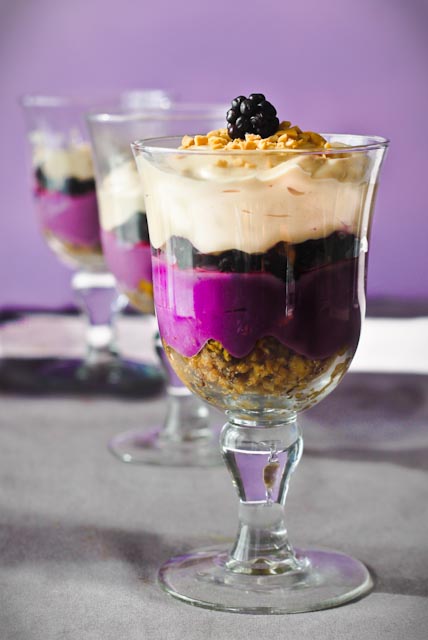
Peanut Butter and Jelly Parfait

Home-packed school lunches were seldom complete without a spongy, white bread peanut butter and jelly sandwich. The gooey snack associates with post swim-practice munchies and the comforting security of grandma's house. I eventually graduated to whole-grain PB&J's as a staple meal in high school, and now I enjoy the grilled ones often offered in Purdue University's dining courts.  

Allyson Kramer, cookbook author and food photographer, twists the elementary lunch into a sophisticated, silken tofu-based parfait. All of her recipes are vegan and, due to a gluten intolerance, gluten free. Her reasoning behind eating vegan aligns with those of the punk's in that she abstains from animal products in order to live a less violent and more eco-friendly lifestyle. 

p b & j parfait

One of my favorite flavor combinations ever is peanut butter and jelly.  Since gluten is off limits for me, it is difficult to satiate my craving with a simple sandwich.  So,  I have resorted to eating  pb&j straight from a giant spoon every now and again.
Okay, I do it a lot.
The inspiration for this parfait is obvious.  Getting my peanut butter and jelly fix this way assures no odd looks from my husband, and it’s a bit less barbaric. Perhaps even fancy.
P B & J Parfait
peanut butter and jelly parfait
makes 3 large parfaits
Ingredients:
First (peanut) Layer:
  • 8 small dates, de-pitted
  • 1/4 cup agave or maple syrup
  • 1 cup roasted peanuts
Second (berry mousse) Layer:
  • 1 package (349g) extra firm silken tofu
  • 4 tbsp raspberry preserves
  • 1/4 cup sugar
  • 1/2 cup blackberries
Third Layer:
  • Fresh Blackberries, cut into smaller sections ( I used a 6 oz. package for all three parfaits- including the 1/2 cup of berries from second layer)
Fourth (peanut butter mousse) Layer:
  • 1 package extra firm silken tofu
  • 5 heaping tbsp creamy natural peanut butter
  • 1/2 cup granulated sugar
  • 1/2 tsp salt (omit if using salted peanut butter)
Topping:
  • 1/2 cup crushed roasted peanuts
Directions:
First layer:
Place all ingredients for first layer into a food processor and chop until crumbly.  Don’t let the food processor go too long or you will have gooey peanut butter!
Divide and spoon into three glasses. Clean out food processor.
Second Layer:
Place all ingredients for second layer into food processor and blend until very smooth.
Spoon into three glasses.  Clean out food processor.
Third Layer:
Evenly place blackberries on next layer of all three parfaits.
Fourth Layer:
Place all ingredients into food processor and blend until very smooth.
Spoon on top of blackberries in all three glasses.
Top each parfait with crushed roasted peanuts and garnish with fresh berries.
You can keep these parfaits in the fridge for a while before serving.  Best served cold. 
Information retrieved from http://allysonkramer.com/about/ and http://www.allysonkramer.com/2010/04/p-b-j-parfait/ on October 9, 2014. 

About the Punk Blogosphere

For the final project, Group 2 chose to analyze punk blogs, as we already know a bit about the punk food subgenre. Some of the blogs are listed below:

http://www.theppk.com/blog/
http://www.punkdomestics.com/blog
http://www.allysonkramer.com/
http://vegan-yums.com/

While looking blogs, we concluded a few things.  The ones the are specifically punk seem to be authored by an older generation and they're the "original" ethical eaters--the gluten free and vegan blogs of the young and trendy are a spin off.  The punk subculture is definitely still there, but in a more dispersed and older demographic.

In comparison to some the blogs that were brought to the recitation table, these are much more succinct in nature.  As Abbie mentioned, "They're more like cookbooks."  Instead of writing a life story with each recipe, these punk blogs are fully functional.  Perhaps they give tips on how to best prepare the dish or what it pairs well with, but the main goal is to provide food.

In addition, there was no unifying location or demographic factor, almost like Indian cookbooks. Men, women, single, married, family, no family, old, young: there was quite a variety in author characteristics. But these authors are not trying to market themselves in a unique way.  They're authentic, original, and honest in their recipes.  They only agenda is advocating for eating well, eating vegan, and making vegan lifestyles easy.

All of these punk blogs post recipes originating from a variety of ethnicities and the authors stem from a multitude of backgrounds.  The Indian cookbooks analyzed in our article were similar in their variance, but may not have been as authentic in what they represented. In total, the main theme we took away from each blog was this: Eat healthy, both for yourself and the environment.

Conscience Quinoa

If you're looking for the perfect grain, look no further than quinoa. Originating from the Andean region of South America, this rice-like seed contains all amino acids and ample amounts of protein.  But be careful what you buy--look for fair trade companies that support sustainable farmers.  It's important to look out for the producers of quinoa, and who knows, there could be one local to you! Quinoa is hardy enough to be grown in many climates.  No wonder 2013 was the "Year of Quinoa."

The following recipe is a flavorful stew for all year.  Cozy up with hearty vegetables in the winter, or substitute in spinach and celery for a lighter summer meal!  Experiment and enjoy.

Quinoa Vegetable Stew, courtesy of Margaret Knudsen

1 tablespoon vegetable oil
1 small onion, chopped
1 red bell pepper, cut into 1⁄2 inch pieces
2 garlic cloves, minced
1 teaspoon paprika
3⁄4 teaspoon ground coriander
1⁄2 teaspoon ground cumin

Heat oil in a medium saucepan over medium heat until simmering. Add the above ingredients and cook, stirring often, until vegetables are softened and spices are fragrant, about 5 minutes. Stir in 1⁄2 cup water, scraping up any browned bits. Stir in:

2 cups vegetable or chicken broth

1 red potato (6 ounces), unpeeled, cut into 1⁄2 inch pieces

Bring to a simmer and cook for 10 minutes

Stir in:
1⁄2 cup quinoa, rinsed

Simmer for 8 minutes. Stir in:
1/3 cup fresh or frozen corn

Continue to simmer until vegetables and quinoa are just tender, 6-8 minutes.

Season with salt and pepper to taste. Serve with:

Chopped cilantro
Chopped avocado
Lime wedges
Crumbled queso fresco cheese or feta cheese